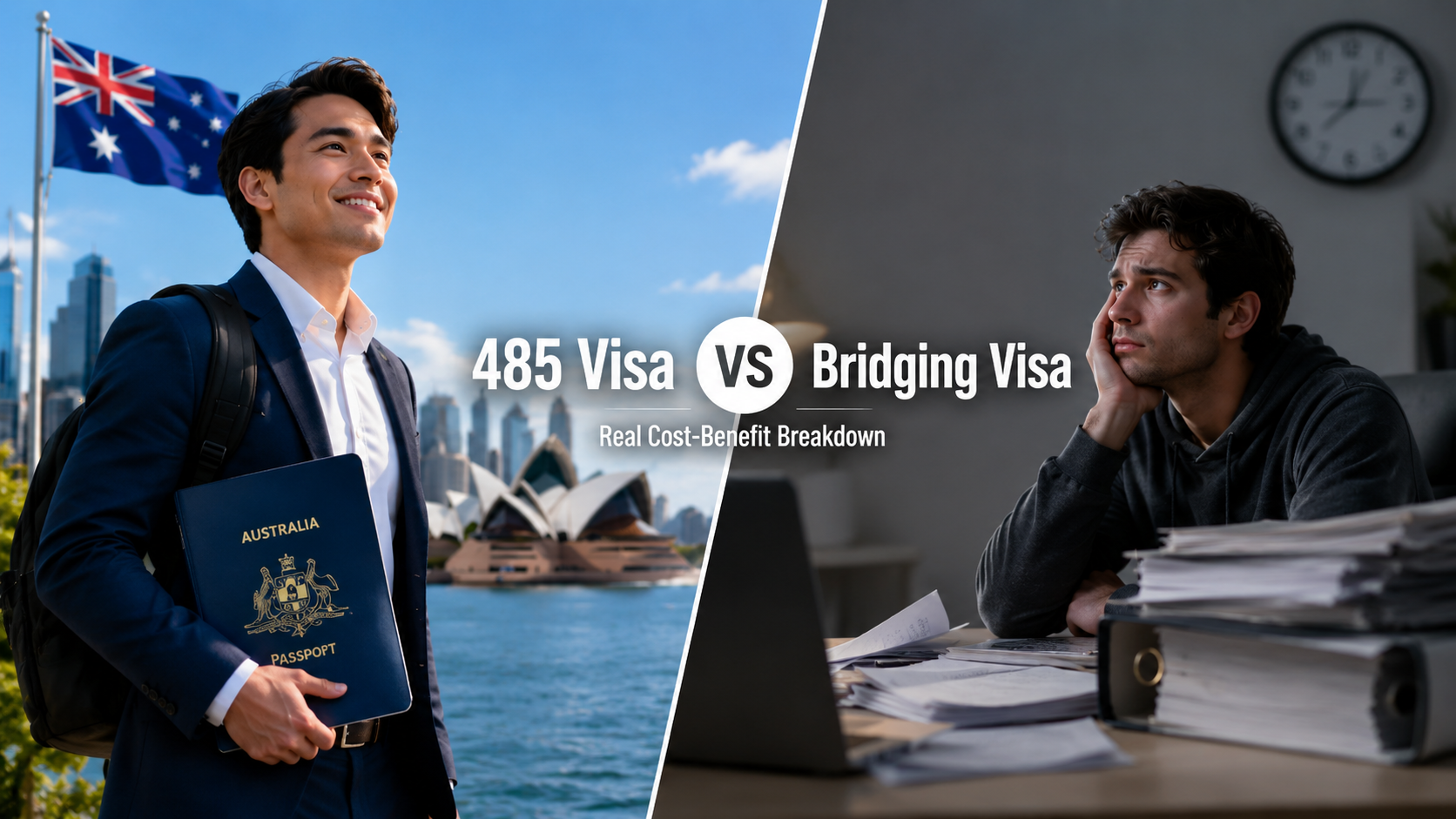
485 Visa vs. Staying on a Bridging Visa — A Real Cost-Benefit Breakdown
For many international graduates, the choice is no longer simple: pay for the temporary graduate visa and buy time to work in Australia, or remain on a bridging visa while another application is decided. The 485 visa Australia cost has risen sharply, but a bridging visa can carry hidden career, travel, income, and stress costs. This breakdown compares the real financial and practical trade-offs so graduates can decide with clearer numbers, not panic.
The Question Graduates Are Really Asking
Graduation should feel like a win. Instead, many students reach the end of their course and face a spreadsheet: visa charge, health cover, English test, police check, rent, savings, and the risk of making the wrong move.
The Temporary Graduate visa subclass 485 allows eligible international students to stay, work, and study in Australia after completing eligible studies. As of March 2026, the starting charge for most primary 485 applicants is AUD4,600, with lower charges applying to some eligible Pacific Island and Timor-Leste citizens.
A bridging visa, by contrast, is usually a holding visa. It keeps a person lawful while an immigration matter is being decided, but it is rarely a long-term career plan by itself. A Bridging Visa A can allow a person to remain in Australia until a substantive visa application is finally decided, while a Bridging Visa C allows lawful stay until a decision is made on a substantive visa application.
What the 485 Visa Gives You for the Money
The strongest benefit of the 485 visa Australia is certainty of purpose. It is built for graduates who need time after study to work, gain local experience, and plan the next step.
The Post-Vocational Education Work stream generally allows an 18-month stay, with longer periods for Hong Kong and British National Overseas passport holders. The Post-Higher Education Work stream allows graduates to stay for 2 to 3 years, depending on the qualification, with work, study, and travel rights during the stay.
That time can be valuable. A graduate who earns even modest full-time income may recover the visa charge within a few months. The deeper value is career evidence: Australian work history, references, payslips, skills growth, and a stronger profile for skilled or employer-sponsored options.
The 485 visa can also make job hunting easier. Employers often prefer a visa with a clear end date and work rights over a bridging visa that depends on another pending application. No visa guarantees employment, but a clearer status can reduce employer hesitation.
The downside is upfront cost. The visa charge is only the first layer. Applicants may also need English testing, adequate health insurance, an Australian Federal Police check, health examinations, document translations, and sometimes skills assessment costs. Home Affairs requires English evidence for some visa applications, and 485 applicants commonly need to prepare police, insurance, and study evidence before lodging. (
What Staying on a Bridging Visa Saves
A bridging visa can look cheaper because there may be no separate government fee for a Bridging Visa A or Bridging Visa C in many standard cases. Some applicants receive a bridging visa automatically after lodging a valid onshore substantive visa application.
That saving is real. For a graduate who already has another strong visa application lodged, such as a partner visa, skilled visa, or employer-sponsored visa, paying for a 485 visa may be unnecessary. In that case, the bridging visa is serving its intended role: keeping the person lawful while the main application is processed.
A bridging visa may also make sense for someone leaving Australia soon, someone with no need to travel, or someone who has already secured a stronger pathway. The key test is simple: is the bridging visa attached to a realistic visa outcome, or is it only delaying a hard decision?
The Hidden Costs of a Bridging Visa
A bridging visa can become expensive without a large invoice.
The first hidden cost is travel restriction. A Bridging Visa A does not give the same travel comfort as a substantive visa. A Bridging Visa B is needed for overseas travel and return during a specified travel period while a substantive visa application is being processed.
The second hidden cost is work uncertainty. Work rights depend on the bridging visa type and conditions. Some people keep similar work rights, while others may need to apply for work permission and show financial hardship, especially in Bridging Visa C situations.
The third hidden cost is career delay. If an employer is unsure about your visa status, you may lose interviews, contract offers, promotions, or sponsorship interest. A graduate who saves AUD4,600 but misses three months of full-time work may lose far more than the application charge.
The fourth cost is pathway risk. Since 1 July 2024, Temporary Graduate visa holders can no longer apply for a Student visa while in Australia, reflecting tighter policy settings around onshore visa changes. Graduates should treat timing as a serious planning issue, not an afterthought.
A Practical Cost Comparison
Think about the decision across four areas: cash, time, work rights, and future value.
The 485 visa usually has the higher upfront cash cost. For most primary applicants, that starts from AUD4,600, before other preparation expenses. Yet it may give 18 months to 3 years of lawful stay, broad work rights, travel ability, and a clearer graduate-to-career bridge.
The bridging visa may cost little or nothing directly, but it depends on another pending application. It can be a smart short-term hold, but a weak long-term plan. Travel may need a Bridging Visa B, work rights may vary, and the visa ends based on the outcome of the underlying matter.
Here is the rough break-even question: can the 485 visa help you earn, gain experience, and qualify for the next step enough to justify the upfront charge?
For a graduate in nursing, teaching, IT, engineering, accounting, social work, trades, or health, the answer may be yes if the time can be used for skilled employment, registration, skills assessment, or sponsorship talks. For someone with no realistic work plan, weak English results, poor savings, or a stronger application already pending, the 485 visa may be less compelling.
Common Scenarios
Scenario 1: You have no other visa application ready.
The 485 visa may be the safer choice if you meet the rules. A bridging visa usually needs an underlying application. Without a valid next application, relying on “bridging” as a plan can leave you exposed.
Scenario 2: You have lodged a strong partner visa application.
A bridging visa may be enough, especially if work rights suit your needs and you do not need overseas travel. Paying for a 485 visa may duplicate costs.
Scenario 3: You need Australian work experience for PR points or sponsorship.
The 485 visa may offer better value. Time in full-time work can build evidence, improve income, and create employer trust.
Scenario 4: You need to travel urgently.
A 485 visa gives travel rights during the stay. A bridging visa holder may need a Bridging Visa B before leaving, and travel periods are specific.
Final Verdict: Cheap Is Not Always Better
A bridging visa can save money today, but the cheapest option can become expensive if it limits work, blocks travel, delays career growth, or leaves you waiting without a strong next step.
The temporary graduate visa is now a serious financial decision. At AUD4,600 for many primary applicants, it should be treated like an investment. The value depends on how you use the time: securing skilled work, building local experience, preparing documents, improving English scores, and moving closer to a realistic long-term visa pathway.