Mirza Ghalib Shayari: Famous Shayari in Hindi and Urdu
Mirza Ghalib was one of the most influential poets of Urdu and Persian literature. Born as Mirza Asadullah Baig Khan in Agra in 1797, he later made Delhi his home and became known by his pen name, Ghalib. He died in Delhi in 1869. His poetry covers love, separation, loneliness, desire, fate, death, human nature and philosophical questions.
What makes Mirza Ghalib shayari so memorable is its ability to express complicated emotions in just a few lines. His couplets can sound romantic, sad, humorous or philosophical, sometimes all at once. Many of his ghazals are still quoted, sung and discussed across India and Pakistan.
If you are looking for famous Ghalib shayari in Hindi, Urdu poetry, romantic shayari or meaningful Ghalib quotes, this collection brings together some of his best-known couplets with simple English meanings.
Who Was Mirza Ghalib?
Mirza Ghalib’s real name was Mirza Asadullah Baig Khan, and “Ghalib” was his poetic pen name. He was born on December 27, 1797, in Agra and died on February 15, 1869, in Delhi.
Although he is particularly remembered today for his Urdu ghazals, Ghalib wrote extensively in Persian as well. In fact, he considered his Persian writing especially important. His Urdu poetry, however, became the work through which later generations came to know and love him most widely.
Ghalib lived during a period of major change in Delhi and witnessed the decline of the Mughal court and the upheaval surrounding 1857. His letters and poetry provide an important literary window into the world in which he lived. Rekhta’s historical record also notes his association with Bahadur Shah Zafar’s court and his writings about the events of 1857.
Famous Mirza Ghalib Shayari in Hindi With Meaning
- हज़ारों ख़्वाहिशें ऐसी कि हर ख़्वाहिश पे दम निकले
बहुत निकले मेरे अरमाँ लेकिन फिर भी कम निकले
Meaning in English: I have thousands of desires, and every desire feels so intense that it could consume me. Many of my wishes have been fulfilled, yet they still seem too few. This is one of Ghalib’s most recognizable couplets. Rekhta lists the ghazal among his widely read works.
- दिल-ए-नादाँ तुझे हुआ क्या है
आख़िर इस दर्द की दवा क्या है
Meaning: My innocent heart, what has happened to you? What could possibly cure this pain? The speaker talks directly to his own heart, turning emotional confusion into a simple but powerful question.
- ये न थी हमारी क़िस्मत कि विसाल-ए-यार होता
अगर और जीते रहते यही इंतज़ार होता
Meaning: It was not my fate to be united with my beloved. Even if I had lived longer, I would have spent that life waiting for the same union. The verse captures the pain of love that never reaches fulfillment.
- कोई उम्मीद बर नहीं आती
कोई सूरत नज़र नहीं आती
Meaning: None of my hopes are being fulfilled, and I cannot see any way out of my situation. The short couplet communicates helplessness without using complicated language. It is part of one of Ghalib’s most recognized ghazals.
- आह को चाहिए इक उम्र असर होने तक
कौन जीता है तिरी ज़ुल्फ़ के सर होने तक
Meaning: A sigh may need a lifetime before it has its effect. Who can live long enough to see the beloved’s tangled affairs finally resolved? The ghazal is among the frequently cited works associated with Ghalib.
- दिल ही तो है न संग-ओ-ख़िश्त, दर्द से भर न आए क्यों
रोएँगे हम हज़ार बार, कोई हमें सताए क्यों
Meaning: It is a heart, not stone or brick, so why should it not fill with pain? If someone keeps hurting us, why would we not cry again and again? The verse reminds us that emotional pain is a natural response rather than a sign of weakness.
- इश्क़ पर ज़ोर नहीं है ये वो आतिश ‘ग़ालिब’
कि लगाए न लगे और बुझाए न बने
Meaning in English: Love cannot be controlled. It is like a fire that cannot simply be started or extinguished whenever you want. Ghalib presents love as something that exists beyond deliberate control.
- हम को मालूम है जन्नत की हक़ीक़त लेकिन
दिल के ख़ुश रखने को ‘ग़ालिब’ ये ख़याल अच्छा है
Meaning: I know the reality of paradise, but the thought of paradise is still comforting enough to make the heart happy. The couplet combines philosophical questioning with Ghalib’s characteristic wit.
- इश्क़ ने ‘ग़ालिब’ निकम्मा कर दिया
वर्ना हम भी आदमी थे काम के
Meaning: Love has made me useless, Ghalib jokes; otherwise, I too was once a capable and useful person. The humour makes the verse particularly memorable. Rekhta includes it among Ghalib’s collected sher-o-shayari.
- उन के देखे से जो आ जाती है मुँह पर रौनक़
वो समझते हैं कि बीमार का हाल अच्छा है
Meaning: When I see my beloved, my face immediately brightens. They think this means my health is improving, while the real reason is simply seeing them. The speaker’s happiness is mistaken for recovery from illness.
- मौत का एक दिन मुअय्यन है
नींद क्यों रात भर नहीं आती
Meaning: The day of death is already destined, so why should I remain awake all night worrying? Ghalib connects everyday restlessness with the certainty of death.
- न था कुछ तो ख़ुदा था, कुछ न होता तो ख़ुदा होता
डुबोया मुझ को होने ने, न होता मैं तो क्या होता
Meaning: When there was nothing, God existed; even if nothing existed, God would still exist. It is my own existence that has caused me trouble—if I had not existed, what would have happened? This is one of his most philosophical couplets and moves beyond romantic poetry into questions about existence.
- रगों में दौड़ते फिरने के हम नहीं क़ायल
जब आँख ही से न टपका तो फिर लहू क्या है
Meaning: I do not consider blood merely flowing through the veins to be enough. If it does not emerge through the eyes as tears, then what meaning does that blood have? Ghalib uses blood and tears to express the intensity of genuine emotion.
- बाज़ीचा-ए-अतफ़ाल है दुनिया मेरे आगे
होता है शब-ओ-रोज़ तमाशा मेरे आगे
Meaning: The world appears like a children’s playground before me, where the events of day and night unfold like a continuous spectacle. The couplet presents the poet as an observer of the changing drama of life.
- रहिए अब ऐसी जगह चल कर जहाँ कोई न हो
हम-सुख़न कोई न हो और हम-ज़बाँ कोई न हो
Meaning: Let us go somewhere where there is no one around—no one to speak with and no one who shares our language. It expresses an intense desire for solitude and escape from social interaction.
- आईना क्यों न दूँ कि तमाशा कहें जिसे
ऐसा कहाँ से लाऊँ कि तुझ सा कहें जिसे
Meaning: Why should I not give you a mirror so that you can see your own beauty? Where could I find anyone worthy of being compared with you? The beloved is presented as so unique that no ordinary comparison seems adequate.
- हर एक बात पे कहते हो तुम कि तू क्या है
तुम्हीं कहो कि ये अंदाज़-ए-गुफ़्तगू क्या है
Meaning: You question me about everything I say. Tell me yourself, what kind of conversation is this? The couplet turns an argument into a playful poetic exchange.
- वो आए घर में हमारे ख़ुदा की क़ुदरत है
कभी हम उनको कभी अपने घर को देखते हैं
Meaning: My beloved has actually come to my home—what an extraordinary thing. I keep looking at them and then at my own home, hardly believing that it is happening. The speaker is so surprised by the moment that he keeps looking around in disbelief.
- बे-ख़ुदी बे-सबब नहीं ‘ग़ालिब’
कुछ तो है जिस की पर्दा-दारी है
Meaning: This state of distraction cannot be without a reason. There must be something hidden behind it. The speaker knows that his emotional state has a cause, even if he does not reveal it.
- बस कि दुश्वार है हर काम का आसाँ होना
आदमी को भी मयस्सर नहीं इंसाँ होना
Meaning: It is difficult for anything to become truly easy. Even becoming genuinely humane is not something that comes easily. This verse shows Ghalib’s ability to turn a simple observation into a comment on human nature.
- इस सादगी पे कौन न मर जाए ऐ ख़ुदा
लड़ते हैं और हाथ में तलवार भी नहीं
Meaning: Who could resist such innocent charm? The beloved can defeat the lover without even holding a sword. The poet uses playful exaggeration to describe the power of beauty.
- पूछتے हैं वो कि ‘ग़ालिब’ कौन है
कोई बतलाओ कि हम बतलाएँ क्या
Meaning: They ask who Ghalib is. Someone tell me—what am I supposed to say? The response is deliberately indirect, giving the couplet a witty and self-aware quality.
Mirza Ghalib Shayari in Urdu
For readers who want mirza ghalib shayari in its original Urdu script, the following selection preserves the traditional form of these well-known couplets.
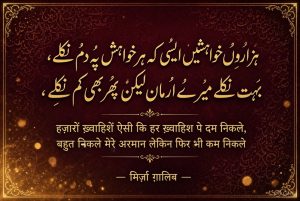
ہزاروں خواہشیں ایسی کہ ہر خواہش پہ دم نکلے
بہت نکلے مرے ارماں لیکن پھر بھی کم نکلے
Meaning: I have countless desires, and each feels powerful enough to consume me. Even after many wishes were fulfilled, they still seemed insufficient.
2.
دلِ ناداں تجھے ہوا کیا ہے
آخر اس درد کی دوا کیا ہے
Meaning: My innocent heart, what has happened to you? What could possibly cure this pain?
یہ نہ تھی ہماری قسمت کہ وصالِ یار ہوتا
اگر اور جیتے رہتے یہی انتظار ہوتا
Meaning: It was not my fate to meet my beloved. Even if I had lived longer, I would have continued waiting.
کوئی امید بر نہیں آتی
کوئی صورت نظر نہیں آتی
Meaning: None of my hopes are being fulfilled, and no solution appears before me.
آہ کو چاہیے اک عمر اثر ہونے تک
کون جیتا ہے تری زلف کے سر ہونے تک
Meaning: A sigh may take a lifetime to have its effect, but who can live long enough to see the beloved’s tangled affairs resolved?
عشق پر زور نہیں ہے یہ وہ آتش غالب
کہ لگائے نہ لگے اور بجھائے نہ بنے
Meaning: Love is uncontrollable. It is a fire that cannot be deliberately lit or put out.
ہم کو معلوم ہے جنت کی حقیقت لیکن
دل کے خوش رکھنے کو غالب یہ خیال اچھا ہے
Meaning: I know the reality of paradise, but the thought of it is still comforting to the heart.
عشق نے غالب نکما کر دیا
ورنہ ہم بھی آدمی تھے کام کے
Meaning: Love has made me useless, Ghalib says humorously; otherwise, I was once a capable man.
ان کے دیکھے سے جو آ جاتی ہے منہ پر رونق
وہ سمجھتے ہیں کہ بیمار کا حال اچھا ہے
Meaning: Seeing my beloved makes my face glow, but they assume that my health is improving.
موت کا ایک دن معین ہے
نیند کیوں رات بھر نہیں آتی
Meaning: Death has a fixed day, so why do I remain awake all night?
نہ تھا کچھ تو خدا تھا، کچھ نہ ہوتا تو خدا ہوتا
ڈبویا مجھ کو ہونے نے، نہ ہوتا میں تو کیا ہوتا
Meaning: When nothing existed, God existed. My own existence is what has caused me trouble; without it, what would there have been to worry about?
دل ہی تو ہے نہ سنگ و خشت، درد سے بھر نہ آئے کیوں
روئیں گے ہم ہزار بار، کوئی ہمیں ستائے کیوں
Meaning: It is a heart, not stone or brick, so why should it not feel pain? Why should we not cry when someone hurts us?
رگوں میں دوڑتے پھرنے کے ہم نہیں قائل
جب آنکھ ہی سے نہ ٹپکا تو پھر لہو کیا ہے
Meaning: Blood simply flowing through the veins means little if it does not become tears when the heart truly suffers.
ہر ایک بات پہ کہتے ہو تم کہ تو کیا ہے
تمہیں کہو کہ یہ اندازِ گفتگو کیا ہے
Meaning: You question me about everything I say. Tell me, what kind of conversation is this?
وہ آئے گھر میں ہمارے خدا کی قدرت ہے
کبھی ہم ان کو کبھی اپنے گھر کو دیکھتے ہیں
Meaning: My beloved has come to my home, and I am so surprised that I keep looking at them and then at my own home.
رہیے اب ایسی جگہ چل کر جہاں کوئی نہ ہو
ہم سخن کوئی نہ ہو اور ہم زباں کوئی نہ ہو
Meaning: Let us live somewhere where there is nobody to speak with and nobody who shares our language.
اس سادگی پہ کون نہ مر جائے اے خدا
لڑتے ہیں اور ہاتھ میں تلوار بھی نہیں
Meaning: Who could resist such innocent charm? The beloved can defeat us without even carrying a sword.
بس کہ دشوار ہے ہر کام کا آساں ہونا
آدمی کو بھی میسر نہیں انساں ہونا
Meaning: Nothing becomes truly easy, and even becoming a genuinely humane person is difficult.
پوچھتے ہیں وہ کہ غالب کون ہے
کوئی بتلاؤ کہ ہم بتلائیں کیا
Meaning: They ask who Ghalib is. Someone tell me what I am supposed to say.
بے خودی بے سبب نہیں غالب
کچھ تو ہے جس کی پردہ داری ہے
Meaning: This state of distraction must have a reason. Something is clearly being kept hidden.
What Makes Ghalib’s Poetry Different?
Ghalib’s style is known for its layered meaning, wordplay and distinctive way of presenting ideas. Rekhta describes his style as marked by originality of expression and a distinctive andaz-e-bayan, or manner of expression.
A single sher can therefore be read in several ways. A line about a lover may also suggest something about human desire. A humorous remark can contain social criticism. A statement about death can become a reflection on the way people spend their lives.
This quality makes Ghalib’s poetry especially rewarding to reread.
Ghalib’s Contribution to Urdu Literature
Ghalib occupies an important position in the history of Urdu poetry. He was associated with the Delhi school of Urdu poetry and wrote extensively in both Urdu and Persian.
His letters are another important part of his literary legacy. His prose became more conversational than the highly formal style common in earlier correspondence, making his letters valuable both as literature and as records of his life and times.
Ghalib also wrote during a period when Delhi was undergoing major political and cultural changes. His writings therefore belong not only to the history of Urdu literature but also to the cultural history of nineteenth-century India.
Wrapping Up
The lasting appeal of Mirza Ghalib shayari comes from the unusual combination of emotion, wit and thought found in his poetry. His verses can speak about love one moment and question existence the next.
Whether you prefer Ghalib shayari in Hindi, original Urdu poetry or English meanings, his couplets offer something for different moods. His words about love, heartbreak, loneliness, life and death continue to be quoted because they capture feelings that do not belong to any single generation.
That is what makes Mirza Ghalib more than a poet remembered from literary history. His shers continue to be read, sung, shared and discussed because the emotions behind them still feel familiar.
Frequently Asked Questions (FAQs)
Q1. What are the most famous Mirza Ghalib shayari?
Some of the most famous Mirza Ghalib shayari include “Hazaron Khwahishen Aisi,” “Dil-e-Nadan Tujhe Hua Kya Hai,” and “Koi Ummeed Bar Nahin Aati.” These verses are known for expressing love, longing, desire, pain, and the uncertainties of life.
Q2. What is the best Mirza Ghalib shayari on love?
“Ishq Par Zor Nahin Hai” is one of Mirza Ghalib’s most famous verses about love. It describes love as a powerful emotion that cannot be controlled by choice. Ghalib’s romantic poetry often combines love with longing, uncertainty, and emotional pain.
Q3. What is the most famous Ghalib quote?
“Hazaron Khwahishen Aisi Ki Har Khwahish Pe Dam Nikle” is one of Ghalib’s most recognized lines. It reflects the endless nature of human desires and the feeling that even after fulfilling many wishes, there can still be something left to want.
Q4. Which Mirza Ghalib shayari is about life?
“Bazicha-e-Atfal Hai Duniya Mere Aage” is a well-known verse in which Ghalib reflects on the world and human life. His poetry often looks at life through themes such as desire, fate, suffering, loneliness, and the changing nature of human experience.
Q5. Which Ghalib shayari is best for heartbreak?
“Ye Na Thi Hamari Qismat Ki Visal-e-Yaar Hota” is one of Ghalib’s best-known verses about separation and unfulfilled love. It expresses the pain of being unable to unite with a beloved and the sadness of waiting for something that may never happen.