
The Complete Guide to Digital Wall of Fame Design in 2026
Schools and universities have spent decades building up physical collections of plaques, trophies, and framed photos. These items take up massive amounts of wall space and eventually gather dust. At some point, administrators look down a crowded hallway and realize they have run out of room to recognize new student achievements or thank recent donors.
The shift to digital displays solves the space problem immediately. A single screen can hold centuries of history without demanding new construction or hallway renovations. But installing a touchscreen is just the hardware side of the equation. The real work is in how you organize, present, and manage the stories you want to tell.
Rethinking How We Recognize Achievement
The traditional approach to honoring students and faculty was simple. Someone won an award, you engraved their name on a piece of brass, and you screwed it to a wooden board. When that board filled up, you bought another one.
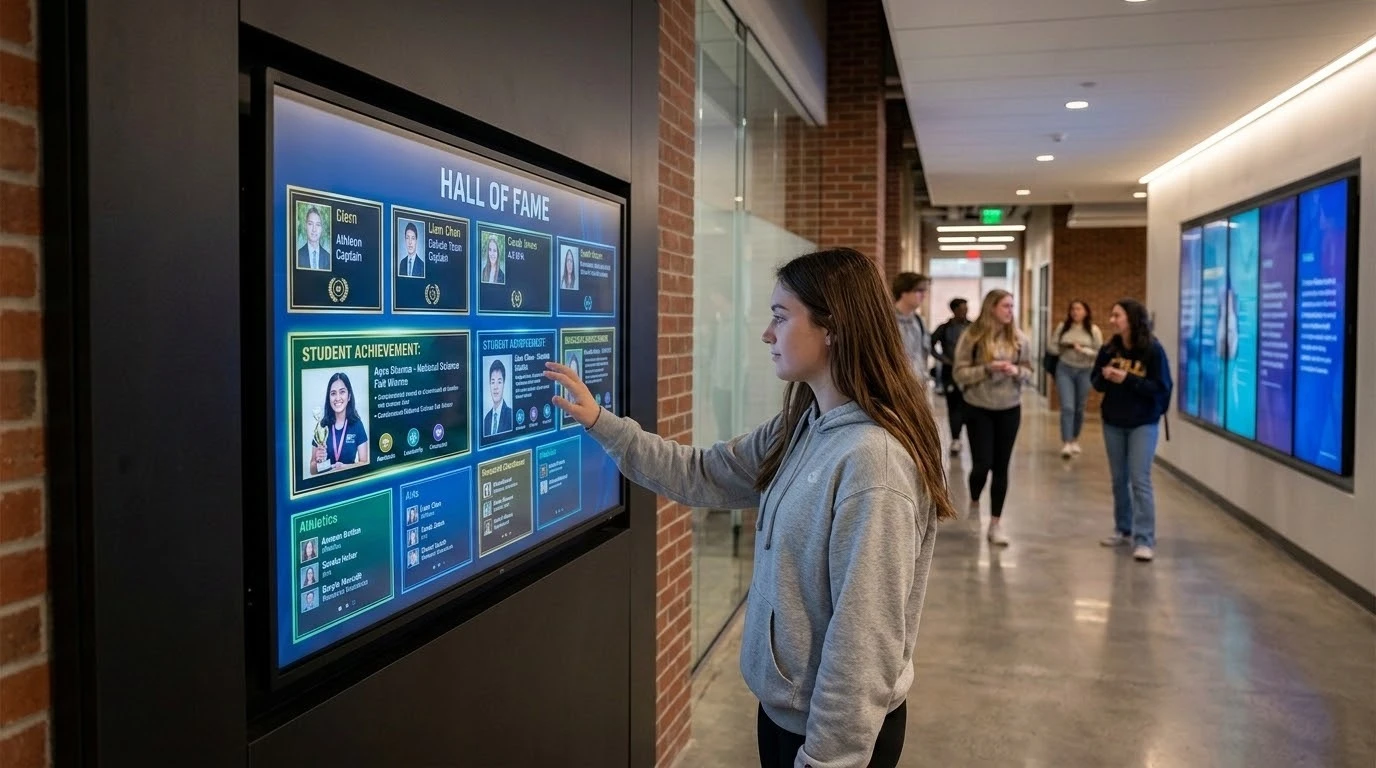
We now have the ability to go much deeper. A modern digital hall of fame doesn’t just show a name and a year. It can show a highlight reel from a championship game, a gallery of student artwork, or a video interview with a retiring principal. You are turning static records into living history.
This level of detail requires a strong content management system. You need cloud based software that lets your staff easily upload photos and update records without needing IT support. If the software is buggy or too complex, your team simply won’t use it, and the display will become just as outdated as the wooden plaques it replaced.
Consolidation and School Identity
Consolidating your history into a single interactive experience does a lot of heavy lifting for your institution’s image. Prospective students and their parents form opinions quickly when they walk through your doors. A modern interactive display signals that your school respects its traditions but operates with state-of-the-art technology.
This is particularly useful for private high schools and universities competing for scholar athletes or top tier academic talent. You want to celebrate your rich history without looking stuck in the past. Highlighting valedictorians, famous alumni, and national championships on a sleek, responsive interface creates a strong impression.
It also helps with community engagement. When alumni return to campus, giving them a way to search for their own class pictures, records, or theater playbills builds immediate goodwill. They can see their legacy is preserved and valued.
Structuring Your Content
When you start planning your content, you need to think about categorization. Users should be able to find what they are looking for with just a few taps.
Athletics is usually the most popular category. You want to include team pictures, captain lists, college commitments, and leaderboards. But a well designed system gives equal weight to academics and the arts. You should have dedicated sections for National Honor Society members, science olympiad winners, and theater set designs.
Do not overlook the overall school history. Include timelines of major milestones, the history behind the school anthem, and explanations of core values. This gives visitors a complete picture of the community they are joining or supporting.
Managing the Donor Experience
Fundraising is a critical function for most private institutions. Recognizing the people who fund your scholarships and facilities is mandatory, but static donor walls are notoriously difficult to update. Engraving new names every year is expensive and logistically frustrating.
A digital wall of fame streamlines this entirely. You can update donor tiers instantly when a new capital campaign closes. More importantly, you can attach impact stories to those names. Instead of just listing a local business that funded a new science lab, you can show photos of students using the lab alongside a short video from a teacher explaining how the new equipment improved their curriculum.
This shows prospective donors exactly what their money does. It moves the focus from simple recognition to tangible impact, which often leads to higher engagement in future fundraising efforts.
Remote Access and Future Proofing
One of the biggest mistakes institutions make is treating their interactive displays as purely physical assets. A good software platform doesn’t limit your reach to the people standing directly in front of the screen in your lobby.
Your content should be accessible from anywhere. A prospective family across the country should be able to browse your athletic records or academic achievements on their phone. An alumnus living overseas should be able to look up their old yearbook photos from their tablet. This broadens your reach and maximizes the return on your investment.
You also have to plan for hardware life cycles. Touchscreens will eventually need replacing as screen technology improves. If your data is locked into proprietary, outdated hardware, you will lose your history when the screen dies. Cloud based databases ensure your legacy is decoupled from the physical display. When it is time to upgrade the hardware in your gym or administration building, your stories, photos, and records simply port over to the new devices.
Focusing on cloud architecture and intuitive software means your school’s history is secure. You get a flexible, scalable platform that grows with your institution, ensuring the bright futures of your current students will be just as easy to document and celebrate.